If there is one universally shared groan in the software engineering world, it’s the mandate to “update the documentation.” We all know it’s crucial for onboarding and system maintenance, but the reality of actually writing it is a massive pain point.
For a brief moment, we thought generative AI would save us from this chore. But if you have ever asked an LLM to explain a massive, undocumented, ten-year-old enterprise codebase, you know exactly what happens: it hallucinates.
Why? Because traditional code is unstructured, fragmented, and full of implicit context.
But what if we could reduce the need to maintain separate structural documentation and give AI a clearer, more structured view of the software?
Enter Model-Driven Development (MDD), the Object Constraint Language (OCL), and the new era of AI-augmented architecture.
The Core Pain: Documentation Drift and AI Hallucinations
Writing documentation is miserable for three reasons:
- The Context Switch: Coding is highly logical. Writing human-readable prose forces your brain to shift into a completely different mode.
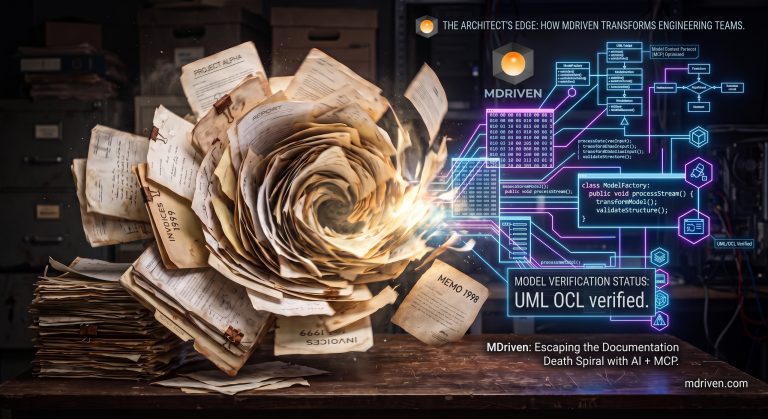
- The Death Spiral (Drift): Code is a living thing. The moment you finish writing a beautiful piece of documentation, a new pull request changes the underlying logic, instantly making your docs outdated.
- The LLM Context Limit: When you try to use AI to generate docs or refactor code, you hit a wall. Feeding millions of lines of spaghetti C# or Java into an AI context window overwhelms the model. The AI cannot “see” the overarching business rules because they are buried inside database queries, API controllers, and random helper classes.
The Solution: UML, OCL, and the Executable Model
Model-Driven Development (MDD) flips this dynamic entirely. In MDD, you don’t start by writing code. You start by creating a formal model of the system’s business logic and data structures.
This model is built on two standard pillars:
- UML (Unified Modeling Language): Defines the structural entities and their relationships.
- OCL (Object Constraint Language): A formal, declarative language used to define the strict business rules (invariants), preconditions, and postconditions that UML diagrams alone cannot capture.
In modern Executable MDD (like MDriven), this model isn’t just a blueprint; it is stored as standard XML and fed into an engine that executes the application directly. The model is the documentation and the application.
Why This is the Ultimate Superpower for AI
This is where the magic happens. UML and OCL can make important parts of a system’s structure and business rules more explicit. When an AI tool has access to those models, it can provide more focused context than code alone.
Here is how structuring your system with MDD turns AI from a basic code-autocomplete tool into a senior architectural partner:
1. More Focused System Context via MCP.
Instead of relying only on a broad code search, an AI tool can use an MCP (Model Context Protocol) connection, where supported, to query selected parts of a system model. Platforms like MDriven expose the system’s UML and OCL structures through these standard endpoints, allowing the AI to dynamically query the model. Because the underlying OCL is mathematically precise and context-aware, the AI instantly achieves a 100% accurate mental model of whatever segment it is looking at. There is zero ambiguity about how entities relate or what rules govern them.
2. High-Value, Structured Feedback
Because the AI truly understands OCL’s rigid rules, it can act as an automated auditor. It can analyze your model and provide structured feedback like:
- “Your OCL invariant for
Customerrequires an active subscription, but yourDeactivateAccountaction’s postcondition leaves the subscription active. This will cause a runtime crash.” - “You have a logical deadlock in your state machine between the
OrderandPaymentclasses.”
It stops guessing about syntax and starts reasoning about actual business logic.
3. Bridging the Gap: Natural Language to OCL
Writing complex OCL can have a steep learning curve for developers. Today, AI can help bridge this gap by turning a plain-language requirement into a draft OCL constraint for review. A Product Manager can write a messy business requirement in plain English: “A user can’t check out if they have restricted items in their cart and are under 18.”
The AI can instantly translate that natural language into a mathematically perfect OCL precondition and apply it to the model.
The Architect’s Edge: How MDriven Transforms Engineering Teams
Moving from traditional hand-crafted code to MDriven isn’t just an infrastructure shift; it’s a massive upgrade in engineering productivity. MDriven offers a different approach: teams can define key structures and business rules in a model that also participates in application development. The benefits depend on how well the model covers the system and how consistently the team maintains it.
Here is how MDriven turns traditional development bottlenecks into competitive advantages:
1. Future-Proof IP Built on Open Standards
Unlike proprietary low-code platforms that trap your logic inside closed systems, MDriven builds on standardized OMG (Object Management Group) specifications: UML, OCL, and XMI/XML. Your business logic remains structured, open, and machine-readable, ensuring your intellectual property is completely future-proofed and ready for any AI integration.
2. The AI-Powered Learning Curve
Historically, mastering precise modeling languages like OCL required dedicated training. Today, AI can lower the barrier by helping developers draft OCL from natural-language requirements, while review by someone who understands the domain and the model remains essential. Because MDriven exposes models via MCP endpoints, developers can simply describe business rules in natural language, and AI assists in drafting precise OCL constraints. Your team gets the rigor of mathematical correctness without the steep friction.
3. Pure Velocity Without Boilerplate
By executing the model directly via the MDriven Turnkey engine, your team stops wasting 80% of their time writing repetitive CRUD operations, REST endpoints, and database mappers. Developers focus exclusively on high-value business logic, allowing small teams to deliver enterprise-grade systems at unprecedented speed.
The Verdict.
By combining the deterministic structure of UML and OCL with the reasoning capabilities of modern LLMs, we are finally moving past the documentation death spiral. You are no longer just writing software; you are teaching AI the exact mathematical rules of your business and letting the engine do the rest.