In systems design, there is a fundamental dividing line between two types of complexity: biological evolution and deliberate engineering.
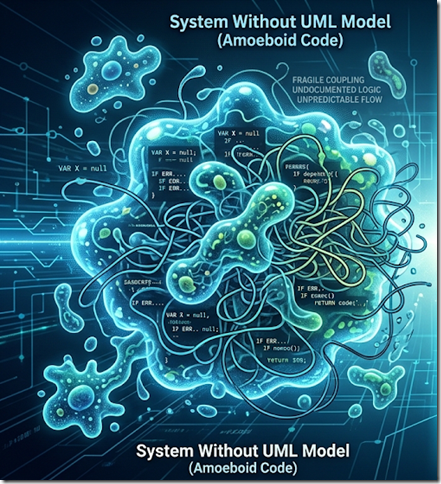
Biology is a masterpiece of high-coupling, emergent complexity. In an organism, almost everything is entangled. A single gene often influences multiple traits (pleiotropy), and a single trait is shaped by dozens of genes (polygenic inheritance). There are no isolated modules, no clean interfaces, and no precise, independent knobs to tweak. When you attempt to modify one piece of a biological system in isolation, side effects cascade across the metabolic web.
Software engineering, by contrast, was invented to escape this exact condition. Through encapsulation, interface segregation, and domain modeling, human software architecture strives to keep variables separated, side effects localized, and dependencies explicit.
Yet, as software development shifts toward massive, unconstrained AI code generation, we are witnessing a strange evolutionary regression: large AI-generated codebases are steadily gliding toward biological complexity.
1. The Absence of Cognitive Pain
Human developers create elegant abstractions not out of abstract virtue, but out of self-preservation.
When a human developer has to untangle a 3,000-line class with scattered state mutation, they experience cognitive friction, frustration, and fatigue. That pain forms a direct feedback loop. It forces the developer to stop, refactor, establish clean boundaries, and enforce separation of concerns so that their future self will not suffer.
AI code generation models feel no cognitive load. An LLM can scan thousands of lines of context, recognize implicit state across disjointed functions, and output a patch that works immediately. Because the AI does not feel the pain of maintaining the system tomorrow, it routinely chooses the path of least local resistance:
- Direct State Mutation: Reaching into globally available context rather than routing data through formal contracts.
- Redundant Abstractions: Duplicate helper functions created in slightly different shapes rather than unifying the underlying model.
- Patch-on-Patch Iteration: Fixing bugs by adding conditional guards rather than refactoring the underlying domain logic.
Over time, this accumulation of locally optimal patches creates global entanglement – a phenomenon best described as code entropy mirroring natural evolution.
2. Evolution vs. Architecture
Biological organisms are not “designed” top-down; they are accumulated history.
When a biological species encounters a new environment or selective pressure, evolution cannot scrap the underlying blueprint and start over with a clean architectural model. It must mutate and build upon whatever machinery already exists. The result is a tangle of evolutionary artifacts: vestigial structures, redundant pathways, and deep interdependencies where new functions are grafted directly onto legacy biological systems.
Unconstrained AI code generation mimics this exact process:
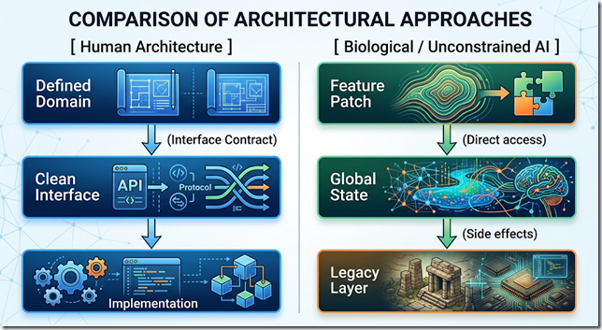
When an LLM is continuously asked to add features or fix bugs in a system without strong architectural constraints, it acts like natural selection. It mutates the existing codebase by appending new logical paths onto older ones. Each iteration solves the immediate prompt, but the system as a whole drifts further away from a coherent, human-comprehensible model.
Eventually, the codebase reaches a threshold where no single component can be altered without triggering unpredictable ripple effects across the entire application – the exact “biology problem.”
3. Why Model-Driven Design (MDD) Matters More Than Ever
Some critics assumed that the rise of AI code generators would render formal modeling and Model-Driven Design (MDD) obsolete. If AI can write thousands of lines of code instantly, why spend time defining explicit models, schemas, and structural boundaries?
The biological analogy demonstrates why this assumption is inverted. As the cost of writing code approaches zero, the value of structural architecture approaches infinity.
Model-Driven Design acts as the structural skeleton that prevents an AI-generated codebase from collapsing into biological soft tissue:
- Separation of Concerns as an Immutable Rule: In a model-driven paradigm (such as MDriven), domain concepts, relationships, and state transitions are explicitly defined at the model layer. The model serves as a rigid contract that the AI cannot bypass or mutate ad-hoc.
- Constrained Generation Boundaries: Instead of letting the AI write arbitrary cross-cutting code, the AI operates within the boundaries enforced by the model. It implements isolated business logic inside explicit, encapsulated handlers.
- Deterministic Refactoring: When domain requirements change, updating the high-level model regenerates the surrounding infrastructure deterministically. This avoids the “patch-over-patch” evolutionary creep that turns traditional codebases into spaghetti networks.
Conclusion: Taming the Ecosystem
If software engineering abandons intentional model design in favor of pure, unconstrained prompt-to-code generation, we will not end up with better engineering – we will end up with biological ecosystems. We will build systems that work, but that no human or machine can precisely tweak, audit, or reason about without triggering unforeseen cascade failures.
The ultimate role of Model-Driven Design in the era of AI is not to write code for us, but to enforce the deliberate architectural boundaries that keep engineering distinct from biology.