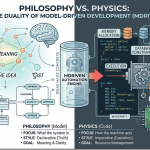
We’ve been conditioned to believe that building complex software requires an army of developers or AI writing millions of lines of code. We celebrate “lines of code” as a metric of progress, but in reality, every line of hand-written code is a future liability. It is a debt that must be serviced through debugging, refactoring, and eventual migration.
If you look closely at any enterprise system, you’ll find that roughly 90% of the codebase is “plumbing.” It’s the repetitive, unglamorous work of moving data from a database to a screen and back again, ensuring the “Save” button doesn’t break the integrity of the data.
What if you could reclaim that 90% and stop building the plumbing to start modeling the house?
The Cognitive Burden of “How”
Most development cycles are consumed by the how. How do we map this object to the database? How do we ensure the UI updates when a value changes? How do we prevent a user from clicking “Approve” when the balance is zero?
When you shift to a modeling mindset, you stop explaining how to the computer and start describing what the business is. By using a tool like the MDriven Designer, you aren’t just drawing a picture; you are defining the DNA of your application. When you define a relationship between an “Invoice” and a “Payment” in a model, you shouldn’t have to write the code to fetch it, display it, or validate it. The model already knows.
A Real-World Example: The “Approval Trap”
Consider a common business scenario: An Expense Approval System.
In a traditional “coding-first” approach, a developer would manually write:
- Database tables for Users, Expenses, and Statuses.
- Code to handle the “Submit” button and change a status string from “Draft” to “Pending.”
- Validation logic to ensure the Manager cannot approve their own expense.
- UI code to hide the “Approve” button if the user isn’t a Manager.
In the Modeling world, this manual work vanishes. You simply draw a State Machine. You define two states: Draft and Approved. You draw a transition between them called Approve. You then add a single guard: self.Amount < 5000 and self.UserWithExpense <> self.ExpenseApprover.
Immediately, the system knows how to store the data, how to restrict the action, and even how to automatically gray out the button on the screen if the conditions aren’t met. You haven’t written a single line of UI-synchronization code or database mapping. You’ve simply described the business reality, and the software has adapted to it.
Declarative Truth over Imperative Chaos
Traditional coding is imperative—a long list of instructions that easily get tangled. Modeling is declarative.
Instead of writing a complex if-else chain to calculate a discount, we use OCL (Object Constraint Language). It’s a precise, side-effect-free way to state a fact. Because this logic lives in the model, it is universally true. It doesn’t matter if the request comes from a web form, a mobile app, or an automated API—the rule is enforced at the core. You no longer need to write validation logic in three different layers of the stack. You define it once, and it “just is.”
The “Last Mile” is Where the Value Lives
If modeling replaces 90% of the work, what happens to the other 10%? This is the most exciting part of the shift.
Freed from the drudgery of CRUD (Create, Read, Update, Delete) and boilerplate infrastructure, your best minds are suddenly available to solve the problems that actually matter. That 10% is your “secret sauce”—the proprietary algorithms, the unique user experience, and the complex integrations that differentiate your business from the competition.
Maintenance is a Myth
In a code-heavy environment, “maintenance” is a constant battle against rot. In a model-driven environment, maintenance looks like evolution. When the business landscape changes—when a new regulation hits or a workflow needs to pivot—you update the model.
The system evolves as a single, cohesive unit. No broken links, no “forgotten” update scripts, and no technical debt from manual hand-offs. You aren’t just building software; you’re building a living map of your business that executes in real-time.
Ready to see the Model in action?
The shift from coding to modeling isn’t just about speed; it’s about clarity. When your model is your “code”, the distance between a business idea and a working solution shrinks to almost zero. You stop being a translator and start being an architect.
To see how these concepts translate into a live system, explore our guide on UML to see how to define workflows without manual logic, or dive into OCL by Example to see how simple expressions replace pages of “if-else” statements. If you’re ready to stop building plumbing and start building value, you can start your first Model today.
The next time you find yourself writing a third validation for the same business rule, ask yourself: Am I building the house, or am I just fighting the plumbing?